
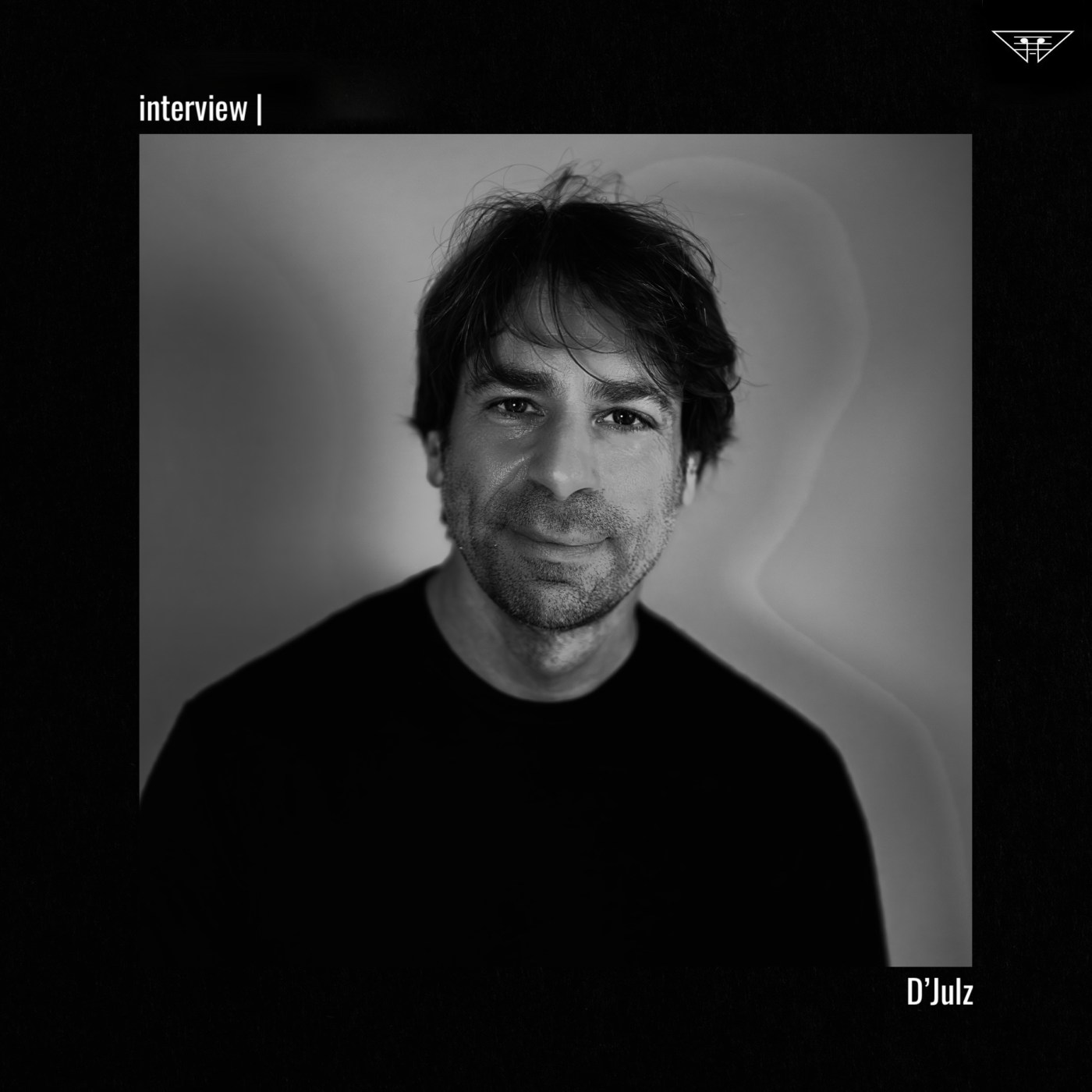
Some careers unfold quietly, not through sudden moments but through years of instinct, patience, and an unwavering sense of groove. D’Julz is one of those rare figures whose presence has become woven into the fabric of underground dance music – not loudly, but unmistakably.
Over more than three decades, the Parisian selector, producer, and label head has helped define the subtle language of house music from the inside. From the raw energy of early 90s Parisian raves to a formative year absorbing the DNA of New York house culture, D’Julz has always moved with quiet confidence – never chasing trends, always trusting the rhythm of the dancefloor. His long-standing Bass Culture label nights at Rex Club became a cornerstone of Paris’ club identity, while his productions have steadily found their way into record bags across the globe.
With the release of the “JV” LP on Bass Culture Records, D’Julz opens another chapter by bringing together a body of work that previously existed only as a vinyl-only outlet for his most personal ideas. A space where tracks could evolve freely, outside of expectations or categories. The result is an album that feels reflective yet open-ended – less a statement than a continuation.
We spoke with him about longevity, intuition, Paris raves, artificial intelligence, and why the most important thing an album can do is simply keep the listener engaged from beginning to end.
A lot of younger DJs have heard me simply because I’ve been around for three decades.
Torture the Artist: You’ve been called a “DJ’s DJ” for years. Does that label feel like recognition, expectation, or quiet pressure?
D’Julz: Obviously, I take it as a compliment, so it’s recognition I would say, but I’m not sure what it really means beyond longevity and consistency. A lot of younger DJs have heard me simply because I’ve been around for three decades. If I’ve influenced some of them or inspired them to start this career, I’m grateful.
Torture the Artist: The “JV” LP feels like a full-circle moment. Why did you feel it was time to bring something so personal and once vinyl-exclusive into a wider space?
D’Julz: I wanted these tracks to reach a wider audience. They work really well together, so the album format felt like the right choice.
Torture the Artist: Since 2018, “JV” has existed almost like a secret notebook – no deadlines, no external expectations. Did that freedom change the way you approached sound?
D’Julz: I feel free every time I make music. I try not to overthink the writing process and do my best to stay in a flow state. It’s only once a track is finished that I start thinking about where it fits – which label, which side, A1 or B2. The real test is simple: do I want to play it? Where? At what time? A lot of these tracks ended up on JV because I couldn’t see them on another label. They probably didn’t fit neatly into a specific genre or trend. That’s why I built this concept around them.
Torture the Artist: There’s something reflective about the album – especially on tracks like “Celestial” or “Le Day”. Do you think you’ve become more introspective with time?
D’Julz: I’ve always made deeper, more introspective tracks. Most of my previous EPs had one of those on them. But sometimes the A1 banger steals the attention — maybe unfortunately.
Torture the Artist: Opening with “J’y Vais” – “I’m going” — feels symbolic. Is this album a departure, a return, or both?
D’Julz: Both, really. “J’y Vais” was the starting point, the first track I wrote when I launched the label. Now that the album is finished, it feels like the end of a chapter… and the start of a new one, still to be defined. So “J’y Vais” makes sense today as well.
Torture the Artist: “Chaplin’s Bong” dives into industrial depth, while “Weekend Warriors” feels sun-soaked and fluid. Do you see these as different emotional states or simply different tools?
D’Julz: I’d say “Chaplin’s Bong” for me feels more aquatic. There’s something sunny in it too, especially with that Italo disco bassline. Both tracks are DJ tools – very stripped down and focused on the groove. They’re not that different in the end. They both go straight to the point.
Torture the Artist: Paris in the early 90s had a very particular rave energy. How did that scene shape your musical identity?
D’Julz: It shaped 80% of the DJ I am today. The rest came from building my skills and fine-tuning my taste.
The French rave scene was my high school. My year in New York was like going to university.
Torture the Artist: You moved to New York in ’93 – a pivotal time for house music. Was there a moment there when you realized this would be your life?
D’Julz: The French rave scene was my high school. My year in New York was like going to university. I learned so much about dance music culture and its history. But it still took me four more years to decide I’d become a full-time DJ.
Torture the Artist: And when you returned to Paris after New York, did the city feel different? Or had you changed more than the city?
D’Julz: Yes, the rave scene was fading out, and some promoters were moving into clubs. New York house was becoming the big sound in those spaces, so I was lucky to come back home with a real NY house degree. It made the transition from rave DJ to club DJ much easier for me.
Staying away from current trends – not always easy – and sticking to the foundations of house and techno is the best way for music to age well.
Torture the Artist: Bass Culture as a label has always felt curated, never rushed. What do you protect most fiercely when running your own imprint?
D’Julz: The word “timeless” comes to mind. Before signing a track, I always ask myself if I’d still play it in ten years. It’s hard to predict, obviously. But with experience, I’ve realized that staying away from current trends – not always easy – and sticking to the foundations of house and techno is the best way for music to age well.
Torture the Artist: Let’s go playful for a second – what’s a track you secretly love that would shock the underground?
D’Julz: My first ever musical crush was the James Bond theme by the legendary John Barry. Definitely not a shameful one – maybe just a surprising one. I actually had fun remixing it recently for the AirFunk label.
Torture the Artist: Do you believe dance music can still be revolutionary, or has it become ritual?
D’Julz: I think musical revolutions are almost always linked to technological shifts. So I’m pretty sure AI – and maybe soon quantum computing – will help shape a new form of dance music. I can’t wait to hear it.
Torture the Artist: “Collective Effervescence” is such a loaded title. Do you think clubs are still spaces for collective transformation?
D’Julz: The good ones, yes. I’m happy to witness it more often than not. But these are precious spaces. They need to be looked after and protected.
Torture the Artist: If you could speak to your 20-year-old self spinning early Paris raves, what would you tell him?
D’Julz: Get ready for the ride – it’s going to last much longer than you think. Don’t overthink it. Follow your gut and your passion. Things will work out just fine.
Torture the Artist: Outside of music – what brings you silence?
D’Julz: Meditation.
Torture the Artist: Last one – when someone presses play on “JV” with no context, no history attached, what do you hope stays with them after the final track fades?
D’Julz: The term may be cliché, but I hope it felt like a real journey… with a beginning, an end, and a few surprises along the way. For me, that’s the only reason an album makes sense from start to finish. The most important thing is not to be boring. If I’ve managed to keep it engaging all the way through, then I’m happy.
Words by Holger Breuer
 Torture the Artist